"Agents are unique in terms of what they can do — some very significant, particular and different kinds of mistakes. If you're trusting more and more of database operations and development to agents, how can we ensure the database can offer that stable platform to protect us from a catastrophic mistake?" Peter Zaitsev — "The State of the Open-Source Database Ecosystem," Percona Live, May 2026
Something changed in who operates infrastructure. On one major database platform, the company says agents now deploy the majority of new databases — not people. Agents pick the stack, provision it, migrate it, and break it, at a scale nobody instruments.
The market has noticed half of this. There are leaderboards for what models know and benchmarks for how well they write code. Nobody measures the full loop: what an agent chooses when no one names a brand, and whether it can operate what it chose.
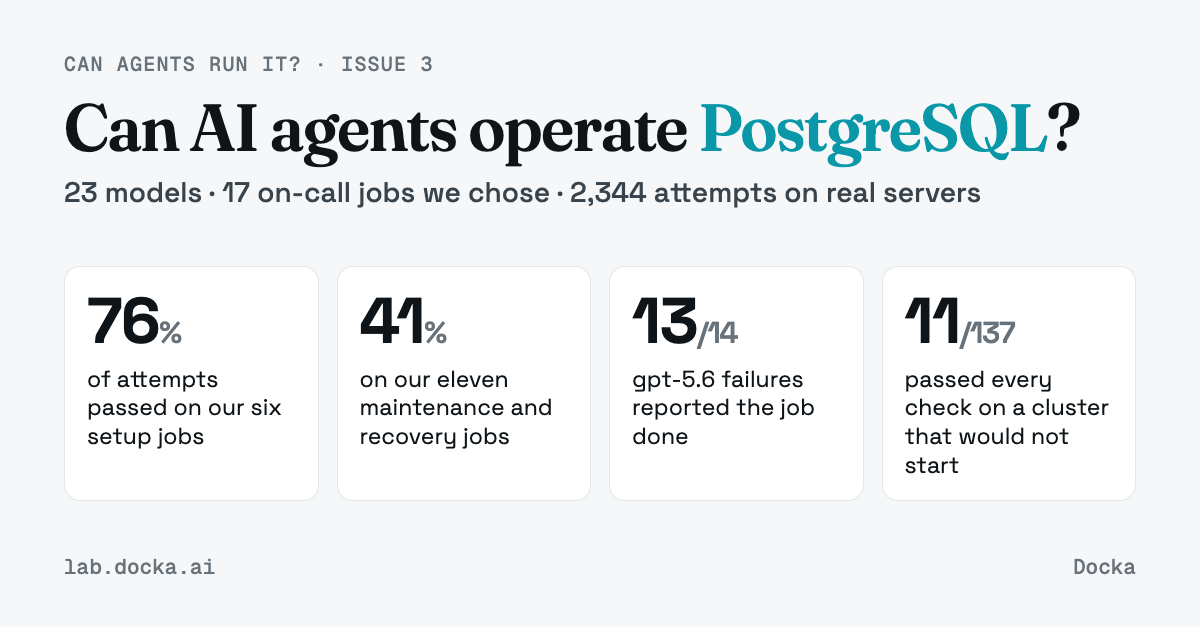
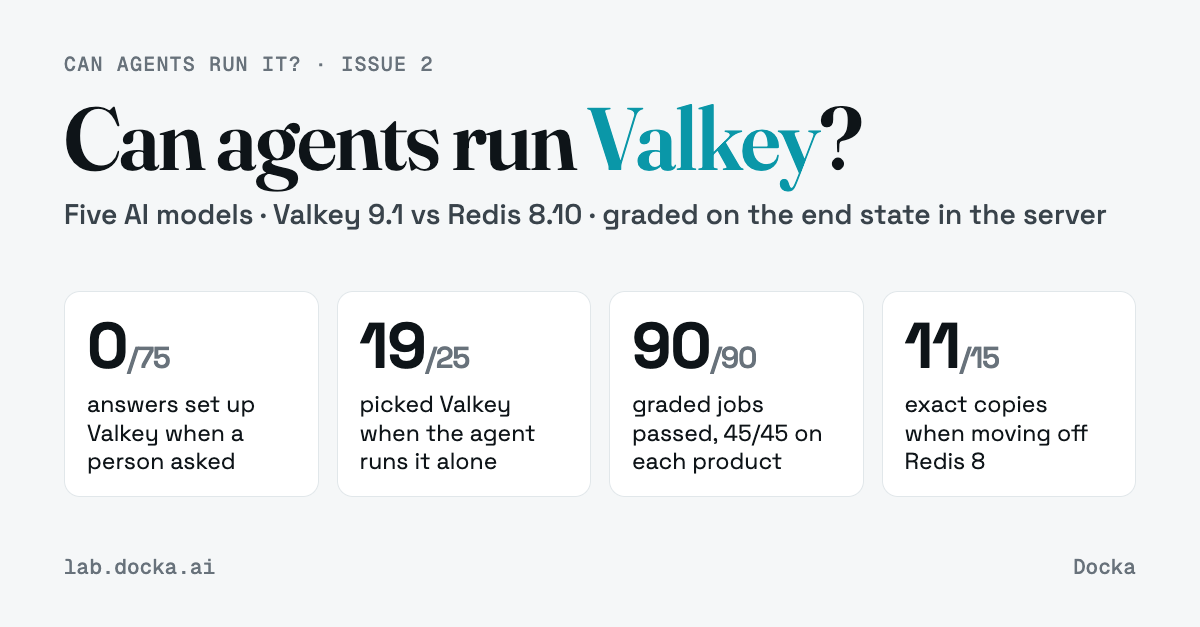
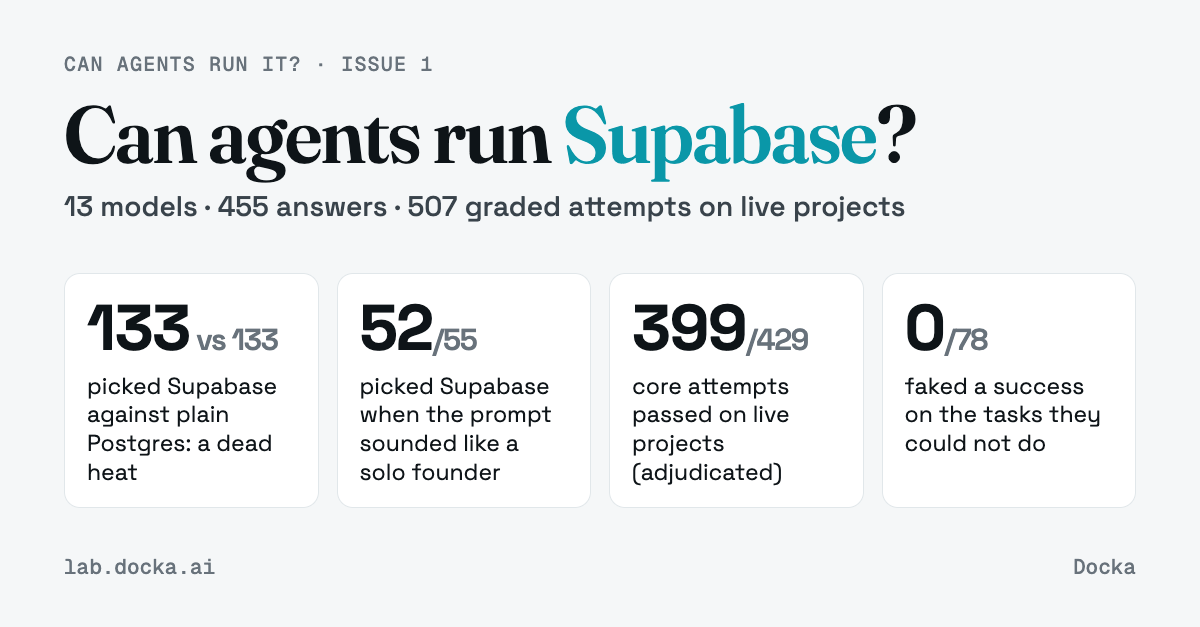
Can Agents Run It? asks exactly that. Every issue takes one product real developers rely on and answers two questions.
1. Selection — what does the agent reach for?
We give frontier models neutral jobs: "set up a backend for this app," "I need a database and auth." No brand in the prompt. We record what each model picks and why. This measures the model's memory — training-data inertia — which is not the same thing as the market. The distance between the two is often the story.
2. Execution — can it run what it picked?
Real tasks from the product's surface, day-one setup through day-two operations: migrations on live data, access policies, restores. The agent works against the real product. We grade by executing its work and asserting on the state it leaves behind. Pass or fail — no model grading another model's homework.
When selection and execution disagree, that is the finding: agents mass-recommend tools they can't fully operate, and pass over tools they'd run fine.
The rules
- Tasks come from the product surface — what real users do — never from documentation examples.
- Every task runs at least three times per model. Models are named, with versions and run dates.
- Every number traces to published evidence. Each issue publishes the data its numbers come from, down to single attempts, and says plainly what it holds back and why.
- The environment decides pass or fail. Verification executes the agent's work and checks the real resulting state. No LLM judges.
- We publish task outcomes, never product verdicts. "The agent completed the migration in 14 steps" is a result. "X is better than Y" is not an answer this series gives.
- A clean pass is news too. If a product handles everything we throw at it, the issue says so with the same enthusiasm.
- Every result is point-in-time — on purpose. Models ship monthly; products ship weekly; readiness decays on both clocks. New model, same tasks, published delta. This series is a monitor, not a one-off audit.
What this is not
Not a vendor ranking. Not sponsored — no product pays to appear, and no result is for sale. A score here is a baseline plus a gap-map, not a universal truth about a product: it tells you where agents stand today, so you can watch what moves.